Read aloud by your device's voice. It sounds different on each device.
Fifty kilometres
It carried water for 50 kilometres to the Roman city of Nîmes
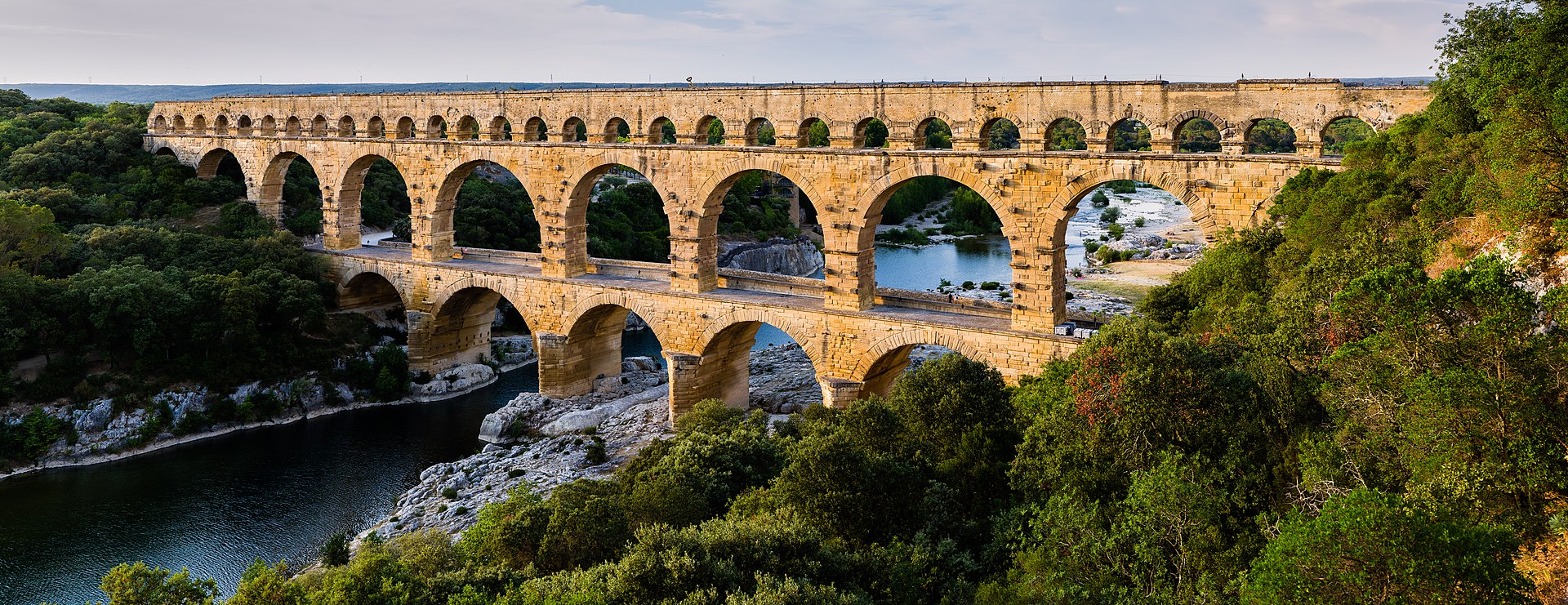
The Pont du Gard was built in the first century AD to carry water over 50 km to the Roman colony of Nemausus, now Nîmes. It carried an estimated 40,000 cubic metres of water a day to the fountains, baths and homes of the citizens.
A gentle slope
The whole aqueduct drops only 17 metres, a slope of about 1 in 3,000
The Fontaine d'Eure spring is only 17 metres higher than the basin in Nîmes, but this was enough for a steady flow to the 50,000 inhabitants. The average gradient is about 1 in 3,000. The water took nearly 27 hours to flow from the source to the city.
17 mthe height difference between the spring and the city, over 50 km
Three tiers
Its engineers lowered the bridge by 6 metres by varying the slope
The bridge has three tiers of arches made from shelly limestone and stands 48.8 metres high. A uniform gradient would have made it infeasibly high, so the engineers varied the gradient along the route and lowered the bridge by 6 metres.
A toll bridge
After Rome the aqueduct became a toll bridge
Lack of maintenance after the 4th century led to clogging by mineral deposits, and the water eventually stopped. After the Roman Empire collapsed, the Pont du Gard remained largely intact and served as a toll bridge. Local lords and bishops were responsible for its upkeep for centuries, with a right to levy tolls.
2000
In 2000 traffic and buildings were removed from the bridge
Some of its stone blocks were looted over time, and serious damage was inflicted in the 17th century. Renovations culminated in 2000 with a new visitor centre and the removal of traffic and buildings from the bridge and the area around it. It was added to UNESCO's World Heritage list in 1985.
Day 8, morning
Next is L'Isle-sur-la-Sorgue.
More stories from this trip idea
The words are a retelling of the Wikipedia article Pont du Gard, and are shared under CC BY-SA 4.0. They are checked against those articles, and a fact that is not in them is left out.