Read aloud by your device's voice. It sounds different on each device.
A spring
A Celtic town grew around a spring known for healing
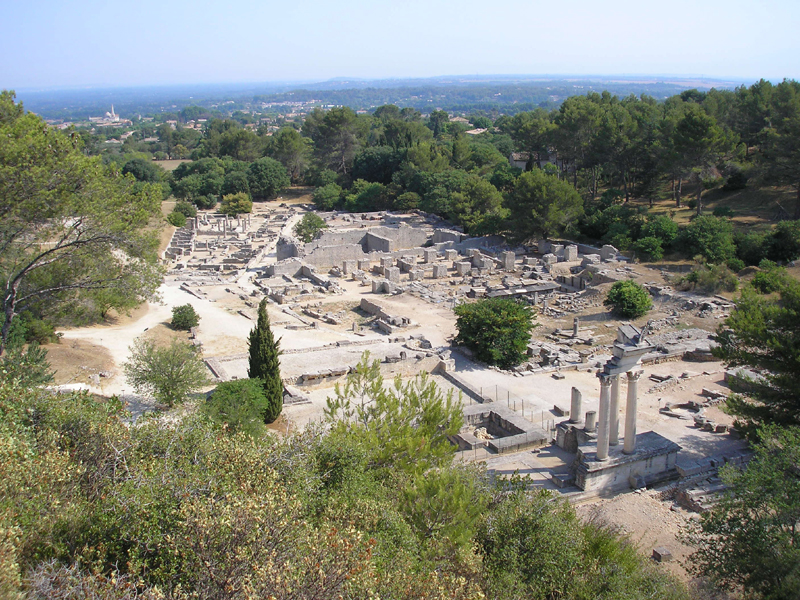
Between the 4th and 2nd centuries BC the Salyens, the largest of the Celto-Ligurian tribes in Provence, built an oppidum, a fortified town, around a spring in the valley. The spring was known for its healing powers, and a shrine was built there to the Celtic god Glanis.
Greek ways
Greek traders brought new building styles and coins
The people of Glanum were in early contact with the Greek colony of Massalia, now Marseille. By the 2nd century BC this influenced their architecture. Fortifications, homes, villas and a bouleuterion were built in the Hellenistic style, and they minted Hellenistic coins with the Greek name of the Glaniques.
Rome
Rome defeated the Salyens in 125 BC, and Glanum became a Roman town
In 125 BC the Salyens were defeated by the army of the Roman consul Marcus Fulvius Flaccus. In the 1st century BC a curved stone arch dam, the oldest known of its kind, and an aqueduct were built to supply the town's fountains and baths.
Les Antiques
The arch built here was the first of its kind in Gaul
A triumphal arch was built at the site between 10 and 25 AD, the first such arch to be built in Gaul. The Mausoleum of Glanum, a towering monument dedicated to members of the Julii family and veterans of Caesar's Gallic Wars, was built about 40 to 30 BC. Together they are known as Les Antiques.
260 AD
The town was overrun in 260 AD, then buried in mud
The town was overrun and destroyed by the Alamanni in 260 AD and abandoned. Its inhabitants moved a short distance north into the plain, founding a city that became Saint-Rémy-de-Provence. The Roman drains were not maintained, so the ruins flooded and were covered with mud, which helped preserve them.
Day 6, midday
It comes after Saint-Paul-de-Mausole. Then Les Baux-de-Provence.
More stories from this trip idea
The words are a retelling of the Wikipedia article Glanum, and are shared under CC BY-SA 4.0. They are checked against those articles, and a fact that is not in them is left out.