Read aloud by your device's voice. It sounds different on each device.
A small island
Delos covers only 3.43 km2 and is one of Greece's great sites
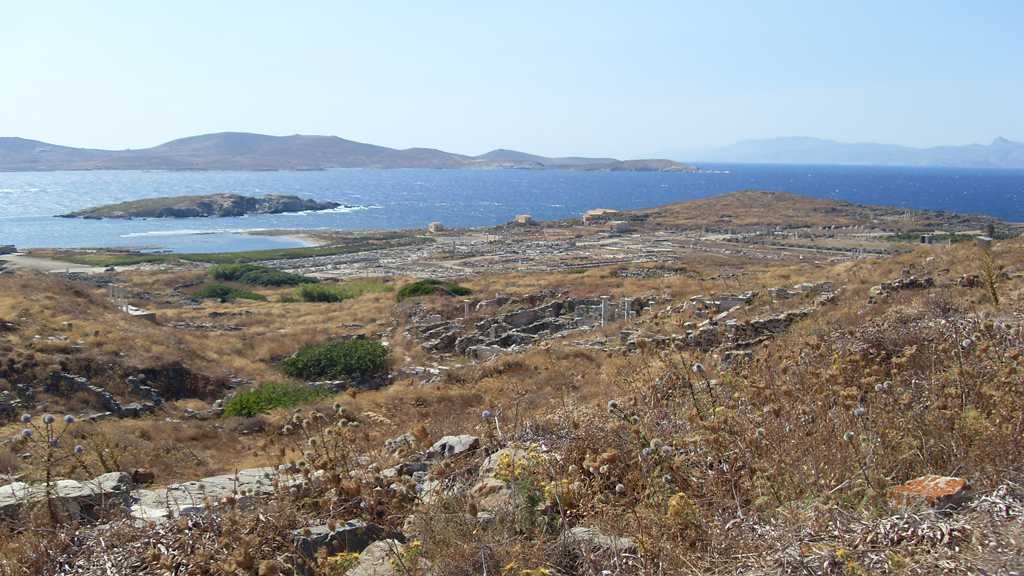
Delos is a small Greek island near Mykonos, close to the centre of the Cyclades. Though only 3.43 km2 in area, it is one of the most important mythological, historical and archaeological sites in Greece. UNESCO added it to the World Heritage List in 1990.
Birthplace
Delos was a holy sanctuary before it was the birthplace of Apollo
Delos was a holy sanctuary for a millennium before Olympian Greek mythology made it the birthplace of Apollo and Artemis. Between 900 BC and 100 AD it was a major cult centre, where the gods Dionysus and Leto, mother of the twin deities, were revered.
Purifications
No one was allowed to be buried or give birth on the island
Athens performed a number of purifications to make the island fit for worship. In the 6th century BC the tyrant Pisistratus ordered that all graves within sight of the temple be dug up. A later decree said no one should be buried or give birth on the island.
The lions
The Naxians set marble lions along the Sacred Way before 600 BC
The Terrace of the Lions was dedicated to Apollo by the people of Naxos shortly before 600 BC. It originally had 9 to 12 squatting, snarling marble guardian lions along the Sacred Way. Today only seven of the original lions remain.
sevenof the original marble lions remain
A free port
From 166 BC Delos was a free port and the centre of the slave trade
In 166 BC the Romans made Delos a free port. It became the centre of the slave trade, with the largest slave market in the region. Attacks by Mithridates VI in 88 and 69 BC and changing trade routes brought decline, and Delos was abandoned around the eighth century AD.
Day 2, morning
Next is Terrace of the Lions.
More stories from this trip idea
The words are a retelling of the Wikipedia article Delos, and are shared under CC BY-SA 4.0. They are checked against those articles, and a fact that is not in them is left out.