Read aloud by your device's voice. It sounds different on each device.
Why
A journalist and a historian pressed for it from the late 1980s
Debate over a memorial began in the late 1980s, when a small group of private West German citizens, led by the journalist Lea Rosh and the historian Eberhard Jäckel, began pressing West Germany to build one. In 1989 Rosh founded a group to support its construction and to collect donations.
The contest
528 designs were sent in to the first competition
In April 1994 a competition for the memorial's design was announced in Germany's major newspapers. Before the deadline the documents were requested over 2,600 times and 528 proposals were submitted. On 25 June 1999 the Bundestag decided to build the memorial designed by Peter Eisenman.
The field
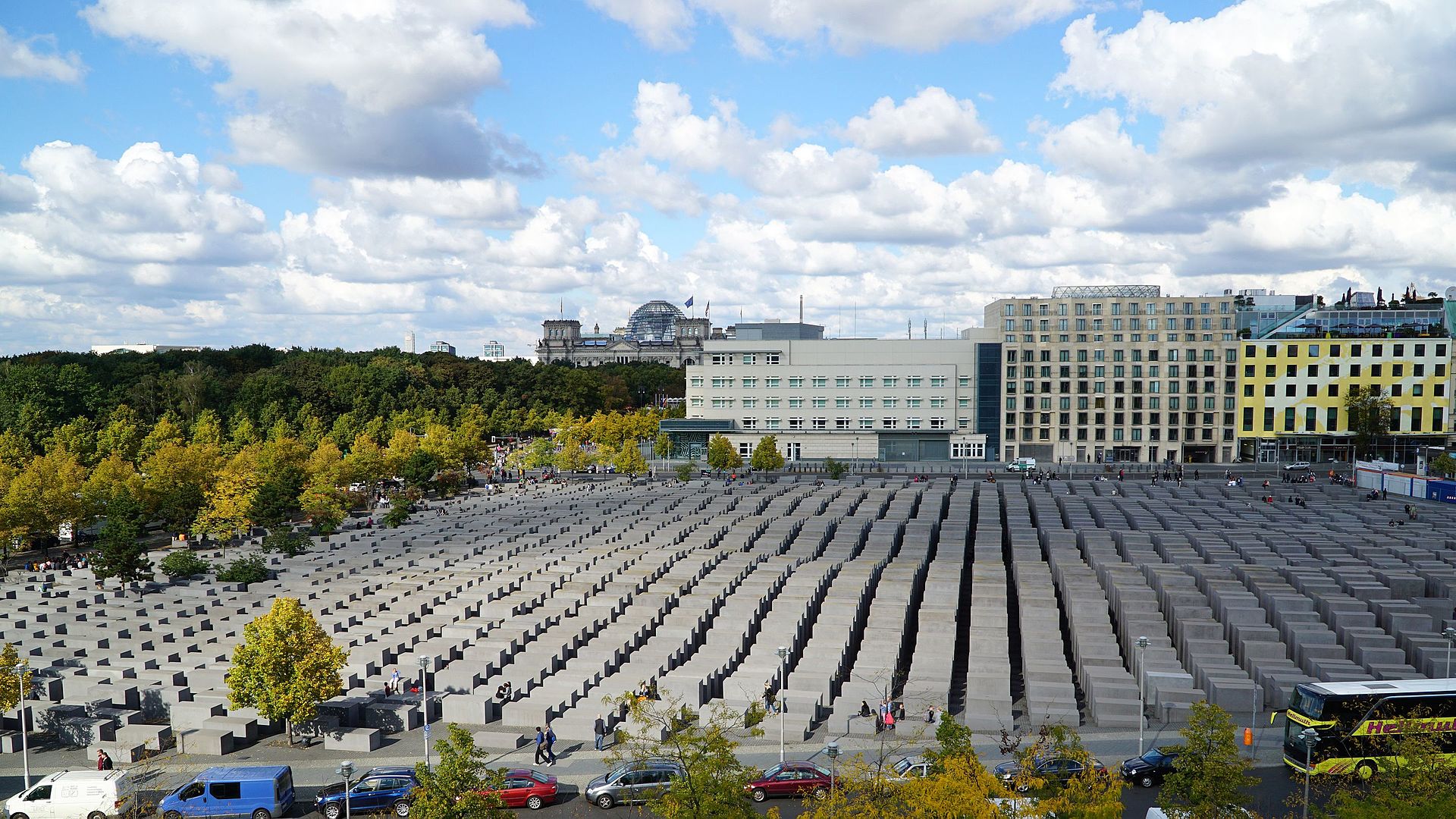
2,711 concrete slabs stand on a sloping field
The memorial covers a 1.9-hectare site with 2,711 concrete slabs, or stelae, arranged in a grid pattern on a sloping field. The original plan was for nearly 4,000, but after recalculation 2,711 could legally fit. The stelae vary in height from 0.2 to 4.7 metres.
2,711concrete slabs on a sloping 1.9-hectare field
The place
It stands on the Wall's border strip, with about 3 million names below
The memorial is one block south of the Brandenburg Gate, on the former location of the Berlin Wall, where the death strip once divided the city. An underground Place of Information holds the names of approximately 3 million Jewish Holocaust victims, obtained from Yad Vashem.
Day 1, midday
It comes after Brandenburg Gate. Then Reichstag Building.
More stories from this trip idea
The words are a retelling of the Wikipedia article Memorial to the Murdered Jews of Europe, and are shared under CC BY-SA 4.0. They are checked against those articles, and a fact that is not in them is left out.