Read aloud by your device's voice. It sounds different on each device.
The gate
It was built in 1788 to 1791 on the site of an older city gate
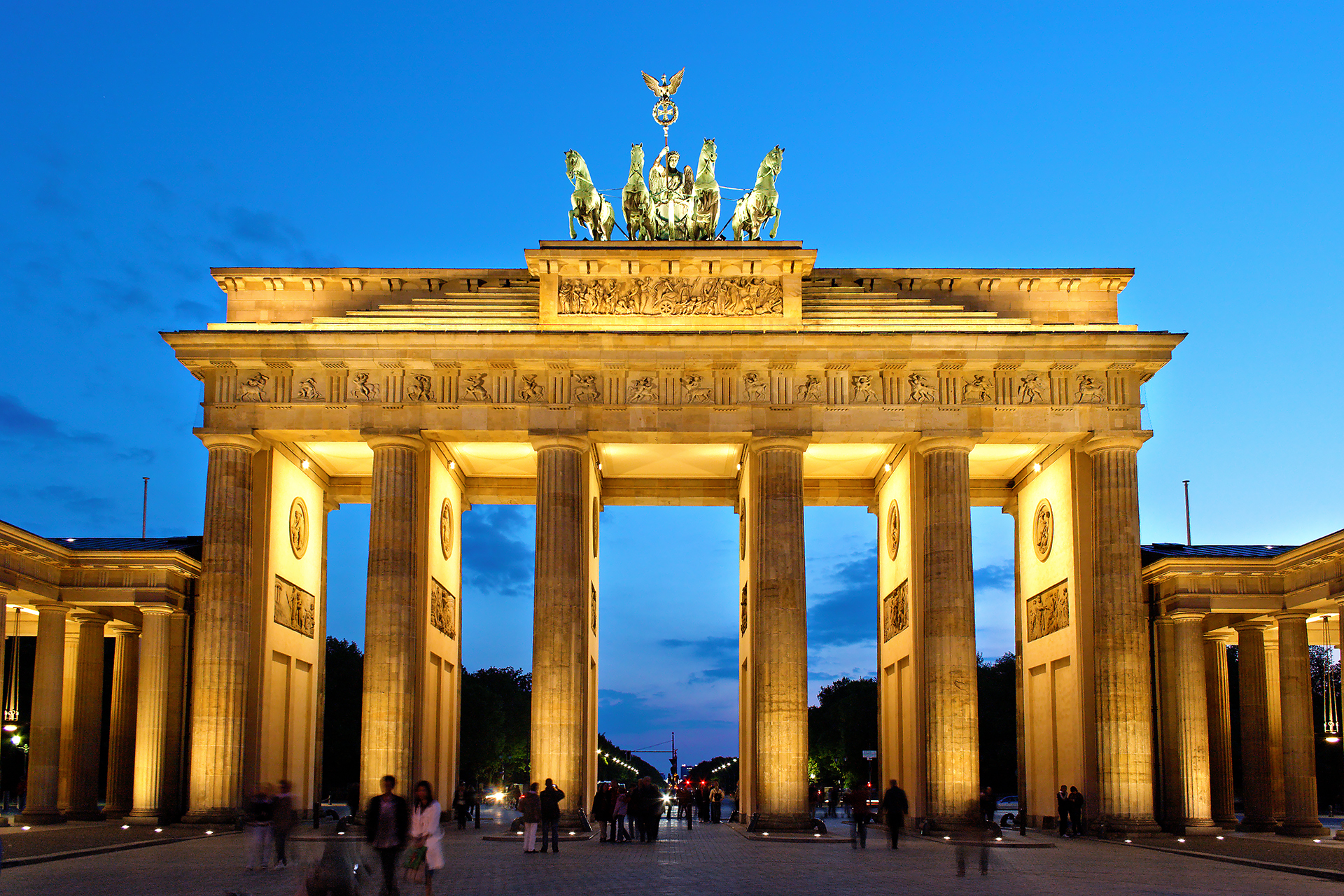
The current structure was built from 1788 to 1791 on the orders of King Frederick William II of Prussia, to designs by the royal architect Carl Gotthard Langhans. It was erected on the site of a former city gate that marked the start of the road from Berlin to Brandenburg an der Havel.
Five passages
Citizens could use only the two outer passages on each side
The gate is supported by twelve fluted Doric columns, six to each side, forming five passageways. Its design is based on the Propylaea, the gateway to the Acropolis of Athens. Citizens were originally allowed to use only the outermost two passageways on each side.
The chariot
The goddess on top was first meant for peace and was renamed for victory
A quadriga, a chariot drawn by four horses, by the sculptor Johann Gottfried Schadow crowns the gate. It was initially intended to represent Eirene, the Greek goddess of peace, but after the Napoleonic Wars was rebranded as Victoria, the Roman goddess of victory. It is the first quadriga group made since antiquity.
Paris
Napoleon took the chariot to Paris in 1806, and it came back in 1814
After the Prussian defeat at the Battle of Jena-Auerstedt in 1806, Napoleon was the first to use the Brandenburg Gate for a triumphal procession, and took its quadriga to Paris. After his defeat in 1814 the quadriga was restored to Berlin.
The wall
For almost three decades the Wall closed the gate
After World War II and until 1989 the Berlin Wall obstructed the gateway, and for almost three decades the gate was a marker of the city's division. A Soviet flag flew on top from 1945 until 1957, when it was replaced by an East German flag. The Wall period ended on 22 December 1989.
Day 1, morning
Next is Memorial to the Murdered Jews of Europe.
More stories from this trip idea
The words are a retelling of the Wikipedia article Brandenburg Gate, and are shared under CC BY-SA 4.0. They are checked against those articles, and a fact that is not in them is left out.