Read aloud by your device's voice. It sounds different on each device.
A residence
Electors and kings lived here for almost 400 years
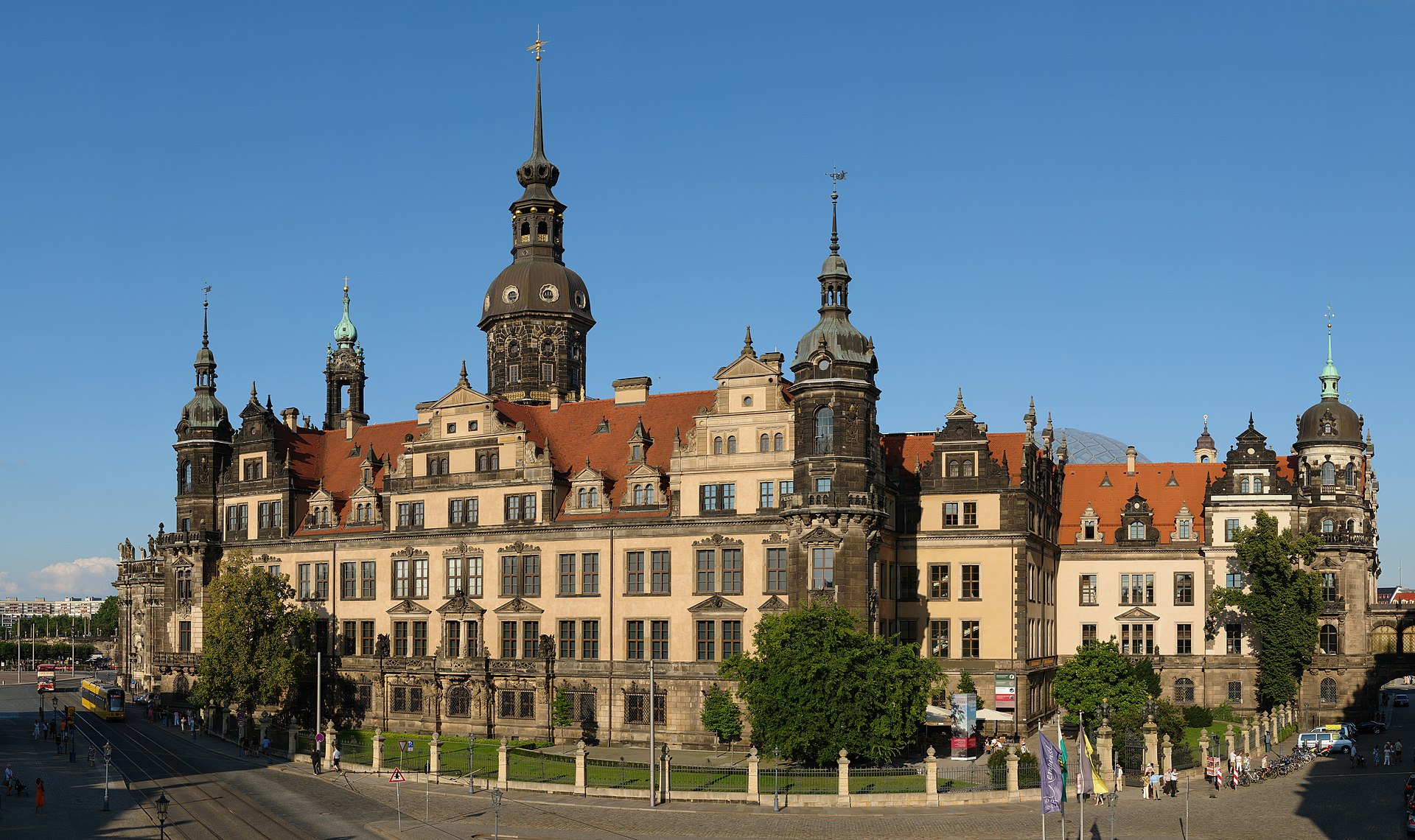
For almost 400 years Dresden Castle was the residence of the electors (1547 to 1806) and kings (1806 to 1918) of Saxony from the House of Wettin, as well as Kings of Poland (1697 to 1763). It is known for the different architectural styles used, from Baroque to Neo-Renaissance.
A keep
It began as a Romanesque keep around 1200
The original castle was a Romanesque keep, built around 1200. The Hausmannsturm was built at the beginning of the 15th century. After a major fire in 1701, Augustus II the Strong rebuilt much of the castle in the Baroque style, and the collection rooms were created in the west wing.
Green Vault
The Green Vault was founded in 1723 as a treasure house
The Green Vault was founded by Augustus II the Strong in 1723. It features a unique and rich variety of exhibits from the period of baroque to classicism, and is made up of the Historic Green Vault and the New Green Vault. It is described as containing the largest collection of treasures in Europe.
Procession
A fading mural was copied onto 23,000 porcelain tiles
On the outside of the Stall Courtyard, the Procession of Princes, a 102-metre-long mural by Wilhelm Walther, shows the history of the Wettins. Because it quickly faded, it was transferred to about 23,000 Meissen porcelain tiles between 1904 and 1907.
23,000Meissen porcelain tiles carry the Procession of Princes
1945
In 1945 the castle became a roofless shell, but the collections were safe
Most of the castle was reduced to a roofless shell in the bombing of 13 February 1945, and three rooms of the Green Vault were destroyed. The collections survived, having been moved to Königstein Fortress early in the war. Restoration is ongoing, and part of the State Apartments reopened in September 2019.
Day 2, midday
It comes after Albertinum. Then Golden Rider.
More stories from this trip idea
The words are a retelling of the Wikipedia article Dresden Castle, and are shared under CC BY-SA 4.0. They are checked against those articles, and a fact that is not in them is left out.