Read aloud by your device's voice. It sounds different on each device.
The island
The broch stood on an island in Clickimin Loch, reached by a stone causeway
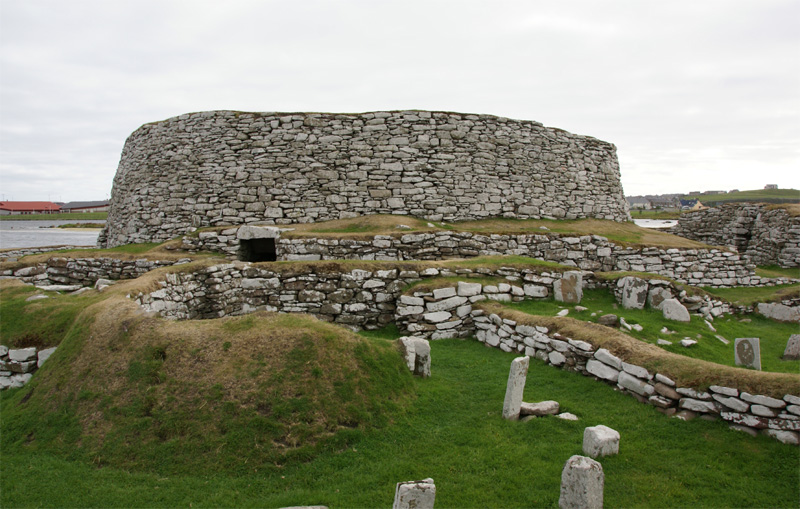
Originally the broch was built on an island in Clickimin Loch and approached by a stone causeway. It now sits on a small promontory jutting into the loch, three-quarters of a mile south-west of Lerwick. It is one of the best preserved broch sites in Shetland.
The gateway
Unusually for a broch, a blockhouse stands between the fort gate and the tower
The broch has an external diameter of around 20 metres and an internal diameter of around 9 metres. It stands inside a walled enclosure, and between the opening in the enclosure and the tower is a large blockhouse, a free-standing drystone gateway. The interior has two cells within the walls at ground level.
Layers of time
Five periods of settlement were proposed for this one promontory
The archaeologist J. R. C. Hamilton, who dug here between 1953 and 1957, proposed several periods: a Late Bronze Age farmstead, an Early Iron Age farmstead, an Iron Age fort, the broch and a wheelhouse settlement. Later archaeologists have challenged his order and usually assume the ring wall, blockhouse and broch were built together.
Daily life
Spindle whorls, querns and two pieces of Roman glass show daily life here
Finds include stone lamps, whetstones, whalebone objects, a die, a few bronze objects and two fragments of Roman glass. Saddle querns show that grain was ground into flour, and spindle whorls show wool being spun into thread. Bones of cattle, sheep and pigs, with red deer, fish and shellfish, show what people ate.
Rebuilt
After major vandalism, parts of the broch were rebuilt by the Office of Works
The broch was first excavated and cleared in 1861. After major vandalism and dilapidation, the Office of Works rebuilt parts of the site, which is why it is called restored. Hamilton's excavation showed that brochs often formed the centre of larger communities where people lived, worked and rebuilt their homes over many generations.
Day 2, morning
Next is Commercial Street.
More stories from this trip idea
The words are a retelling of the Wikipedia article Broch of Clickimin, and are shared under CC BY-SA 4.0. They are checked against those articles, and a fact that is not in them is left out.