Read aloud by your device's voice. It sounds different on each device.
The slide
A mudslide buried part of a Makah village, with its houses
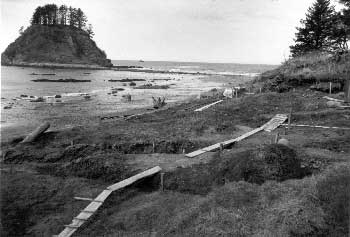
A mudslide engulfed part of the Makah village of Ozette, near Lake Ozette on the coast. It preserved several houses and their contents in a collapsed state until the 1970s. The oral history of the Makah mentions a great slide that engulfed a portion of Ozette long ago.
“The oral history of the Makah mentions a "great slide" which engulfed a portion of Ozette long ago.”
Makah oral history, as the Ozette article records it
The storm
A storm in February 1970 exposed hundreds of wooden artifacts
Test pits were dug at the site in 1966 and 1967, but it was not until 1970 that it became apparent what was buried there. After a storm in February 1970, tidal erosion exposed hundreds of well-preserved wooden artifacts. The excavation went on for 11 years, with students and the Makah using pressurized water to remove mud from six buried long houses.
55,000Artifacts recovered from the site
The finds
Roughly 30,000 of the artifacts were made of wood
The more than 55,000 artifacts span a period of occupation of around 2,000 years, from whale and seal hunting to salmon and halibut fishing, and from toys and games to bows and arrows. Roughly 30,000 were made of wood, which is extraordinary because wood generally decays fast. Hundreds of knives had blades of mussel shell, sharpened beaver teeth, or iron.
The museum
The museum opened in 1979 with replica longhouses and canoes
The Makah Museum opened in 1979 at the Makah Cultural and Research Center. It displays replicas of cedar long houses as well as whaling, fishing, and sealing canoes. Ozette was occupied before frequent European visitation, so it was in existence before smallpox and other foreign diseases decimated the population.
The treaty
In 1855 the Makah ceded much of their land by treaty
On January 31, 1855, government-selected Makah representatives signed the Treaty of Neah Bay with the U.S. federal government, ceding much of their traditional lands. The treaty required the Makah to be restricted to the Makah Reservation, and preserved their rights to hunt whales and seals in the region. The Makah language was not used during the negotiation of the treaty.
In this plan
It is one of the stops on this plan.
More stories from this trip idea
The words are a retelling of the Wikipedia article Ozette Indian Village Archeological Site and the Wikipedia article Makah, and are shared under CC BY-SA 4.0. They are checked against those articles, and a fact that is not in them is left out.