Read aloud by your device's voice. It sounds different on each device.
The first
A king's observatory, built slightly over budget
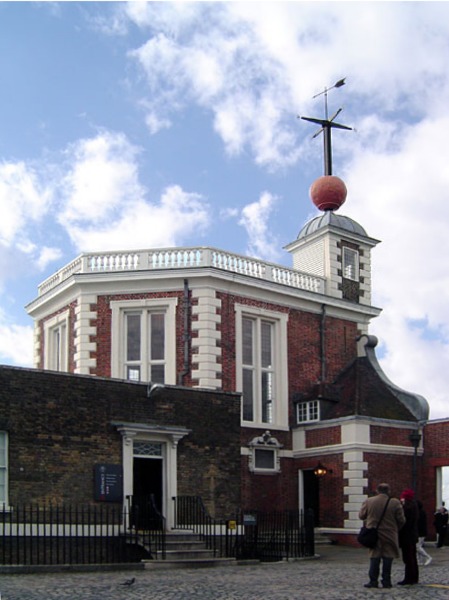
Charles II commissioned the observatory in 1675, and the foundation stone was laid on 10 August. Christopher Wren designed Flamsteed House, built in 1676 largely from recycled materials on the foundations of Duke Humphrey's Tower.
13 degreeshow far Flamsteed House's alignment is from true North
“...so as to find out the so much desired longitude of places for the perfecting of the art of navigation”
The post of Astronomer Royal, created in 1675
The clocks
Two clocks with 13 foot pendulums, true to seven seconds a day
Sir Jonas Moore gave the key instruments at his own cost, including two clocks by Thomas Tompion for the Octagon Room. Each had a pendulum 13 feet long above the clock face, a period of four seconds, and an accuracy then unparalleled of seven seconds per day.
The signal
A dropped ball, then telegraph wires, then the radio
Daily time signals began in 1833, marked by dropping a time ball. Time signals went out along telegraph lines in 1852, and the hourly Greenwich Time Signal was first broadcast on 5 February 1924.
The meridian
In 1884 the world chose this line as its zero
The meridian through the Airy transit circle, first used in 1851, was adopted as the world's Prime Meridian at the International Meridian Conference in Washington, DC, on 22 October 1884. Nations around the world then used it for mapping and timekeeping.
The line today
Now a steel strip by day and a green laser at night
The Prime Meridian was marked by a brass strip, later stainless steel, in the courtyard once the buildings became a museum in 1960. Since 16 December 1999 it has also been marked by a powerful green laser shining north across the London night sky.
Day 4, evening
It comes after Greenwich Market.
More stories from this trip idea
The words are a retelling of the Wikipedia article Royal Observatory, Greenwich, and are shared under CC BY-SA 4.0. They are checked against those articles, and a fact that is not in them is left out.