Read aloud by your device's voice. It sounds different on each device.
The night before
The night before Holi, bonfires are lit and people gather to sing
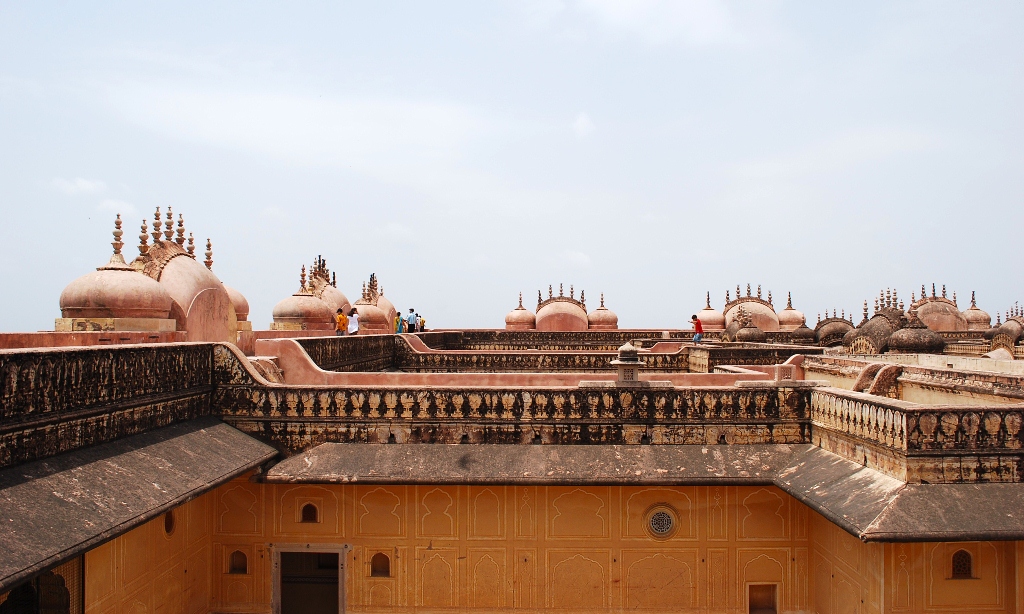
Holi begins on the full moon day, Purnima, in the Hindu month of Phalguna, around the middle of March. The night before, bonfires are lit in a ceremony known as Holika Dahan, and people gather near the fires, sing and dance. Above Jaipur, on the edge of the Aravalli Hills, Nahargarh Fort looks over the city.
The spirit
A spirit named Nahar is said to have obstructed the building
The fort was first named Sudershangarh but became known as Nahargarh, which means abode of tigers. The popular belief is that Nahar stands for Nahar Singh Bhomia, whose spirit haunted the place and obstructed construction. It was pacified by building a temple in his memory within the fort.
A ring of forts
Built in 1734 as a place of retreat above the city
Maharaja Sawai Jai Singh built it mainly in 1734, as a place of retreat on the summit of the ridge above the city. With Amber Fort and Jaigarh Fort, Nahargarh once formed a strong defence ring for the city, and walls ran over the hills to connect it to Jaigarh.
1734the year it was mainly built
The time signal
A gun fired from the fort gave Jaipur its time signal
Until April 1944, the Jaipur State government used for its official purposes solar time read from the Samrat Yantra in the Jantar Mantar Observatory. A gun fired from Nahargarh Fort gave the time signal.
1944the year the signal gun was last relied on
A safe place
The fort never came under attack, but it sheltered families in 1857
Nahargarh never came under attack, though it saw treaties with the Maratha forces who warred with Jaipur in the 18th century. During the Indian Mutiny of 1857, Sawai Ram Singh moved the Europeans of the region, including the British Resident's wife, to the fort for their protection. Madhavendra Bhawan still has delicate frescoes.
In this plan
It is one of the stops on this plan.
More stories from this trip idea
The words are a retelling of the Wikipedia article Nahargarh Fort and the Wikipedia article Holi, and are shared under CC BY-SA 4.0. They are checked against those articles, and a fact that is not in them is left out.