Read aloud by your device's voice. It sounds different on each device.
The forum
The temple was built around the 1st century for Augustus
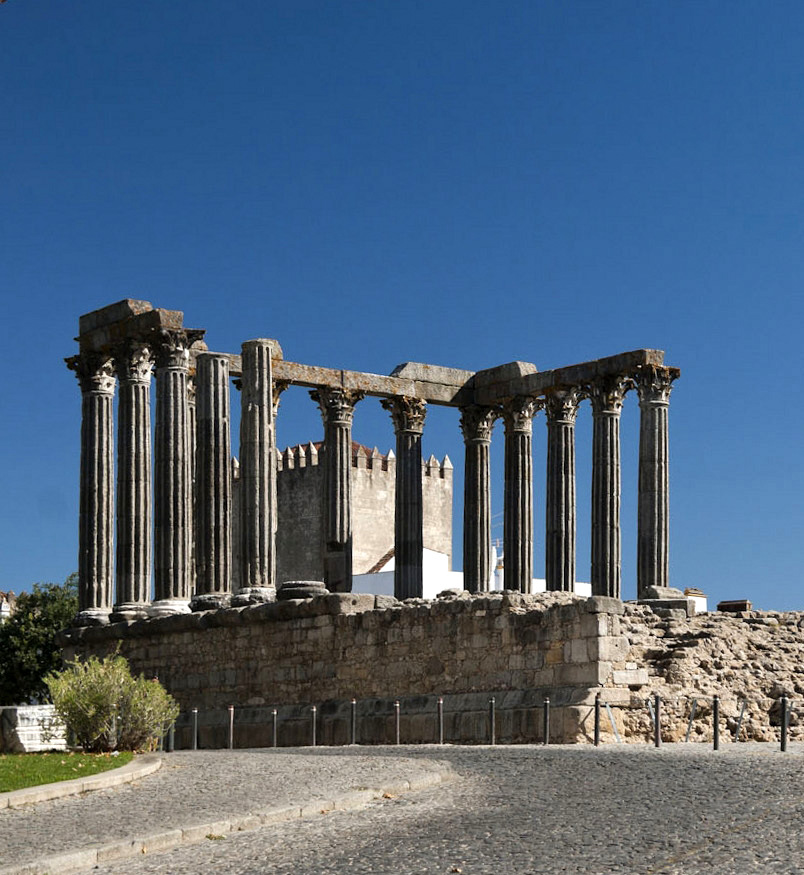
The temple is believed to have been built around the 1st century CE, in honour of Augustus, who was venerated as a god during and after his rule. It stood in the main public square, the forum of Évora, then called Liberalitas Iulia.
A tower
The temple became a tower, then a butcher shop until 1836
The ruins of the temple were incorporated into a tower of the Castle of Évora during the Middle Ages. The base, columns and architraves stayed embedded in the walls. The tower was a butcher shop from the 14th century until 1836, which helped preserve the remains.
Not Diana
The name Temple of Diana comes from a legend of the 17th century
Any link with the Roman goddess of the hunt stems not from archaeology but from a legend created in the 17th century by the Portuguese priest Manuel Fialho. Other readings suggest that the temple might have been dedicated to Jupiter.
Uncovered
The medieval additions were cleared by Giuseppe Cinatti
In 1840 buildings annexed to the northern façade, linked to the Portuguese Inquisition, were demolished and Portugal's first great archaeological excavation was undertaken. In 1869 Augusto Filipe Simões proposed removing the medieval structures. Three years later, under Giuseppe Cinatti, they were removed.
What remains
A granite base and a colonnade of six columns remain
What remains is the complete base, made of granite blocks, with the ruins of a staircase. Along the northern facade is an intact colonnade of six columns with architrave and frieze. The original temple was probably similar to the Maison Carrée in Nîmes.
Day 1, morning
Next is Evora Cathedral.
More stories from this trip idea
The words are a retelling of the Wikipedia article Roman Temple of Évora, and are shared under CC BY-SA 4.0. They are checked against those articles, and a fact that is not in them is left out.