Read aloud by your device's voice. It sounds different on each device.
1849
The first permanent bridge over the Danube opened in 1849
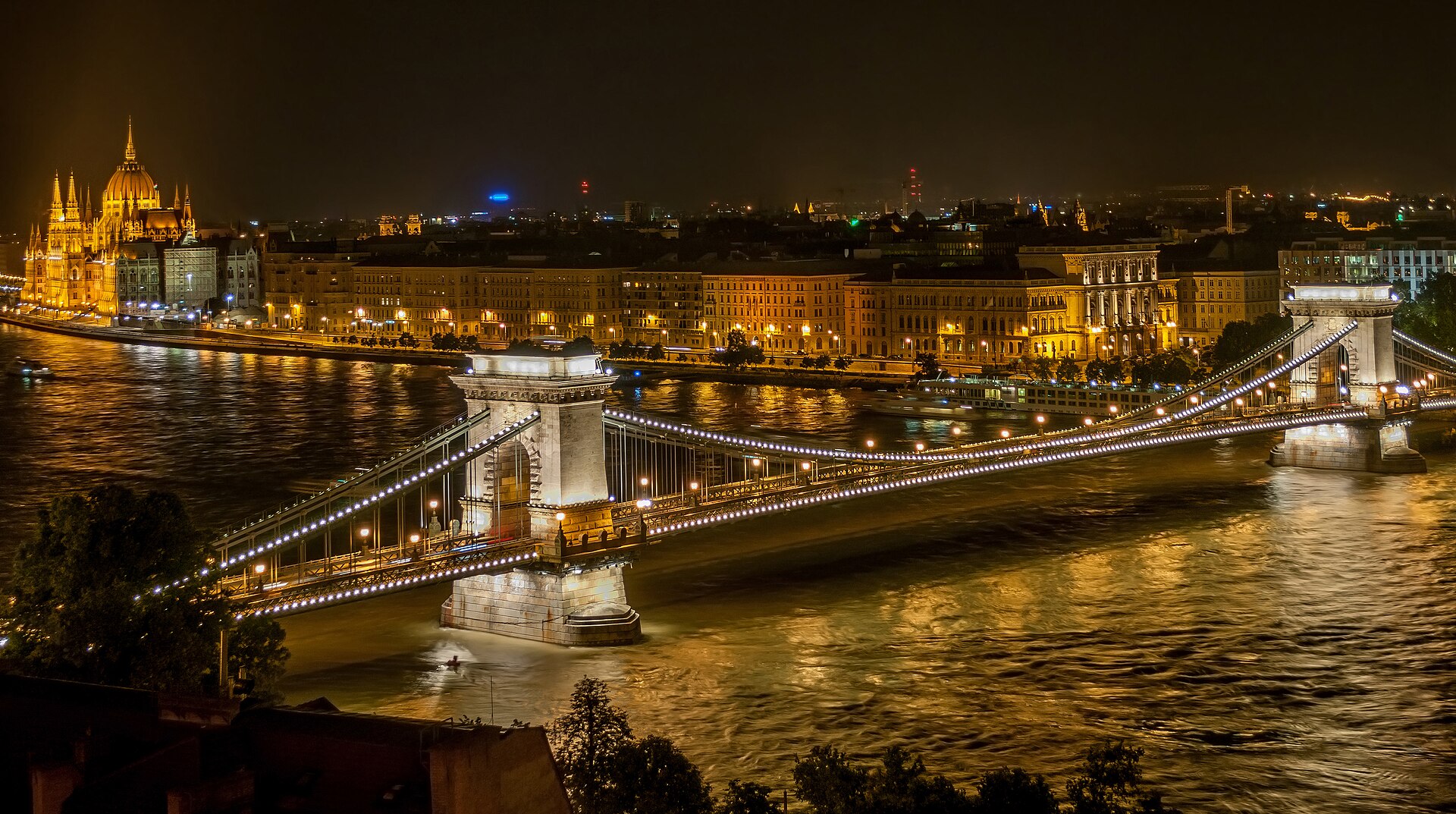
The bridge was designed by the English engineer William Tierney Clark, and the Scottish engineer Adam Clark supervised the building. It was the first permanent bridge across the Danube in Hungary and opened in 1849. At that time its centre span of 202 metres was one of the largest in the world.
202metres across, one of the longest spans in the world in 1849
Széchenyi
A count asked for it, and a Greek merchant helped pay
The bridge followed an initiative by Count István Széchenyi, and it bears his name. It was designed in sections and shipped from the United Kingdom to Hungary for final construction. The Greek merchant Georgios Sinas paid for a large share of it, and his name is cut into the base of a foundation on the Buda side.
The lions
The stone lions were added in 1852, and they do have tongues
The lions at each end were carved in stone by the sculptor János Marschalkó and installed in 1852. A Hungarian legend says that they have no tongues. That is not true: the tongues are simply not visible.
Marlow
It is a larger copy of a bridge on the Thames
The bridge is a larger-scale version of William Tierney Clark's earlier bridge at Marlow, over the River Thames in England. A plaque on the Pest side marks the only two surviving bridges that he designed, the Chain Bridge and the suspension bridge at Marlow.
1945
It was blown up in 1945 and reopened in 1949
On 18 January 1945 the retreating Germans blew up the bridge during the Siege of Budapest, and only the towers remained. It was rebuilt and reopened in 1949. It was closed to traffic for renovation between March 2021 and August 2023.
Day 2, evening
It comes after Dohány Street Synagogue.
More stories from this trip idea
The words are a retelling of the Wikipedia article Széchenyi Chain Bridge, and are shared under CC BY-SA 4.0. They are checked against those articles, and a fact that is not in them is left out.